





Account & Billing
Rates and Tariff Information
Electric rates can be complex, but we’re here to make them simple. Below is a clear overview of each rate—who it applies to and how it impacts your bill.
Our Commitment to Fair, Stable Rates
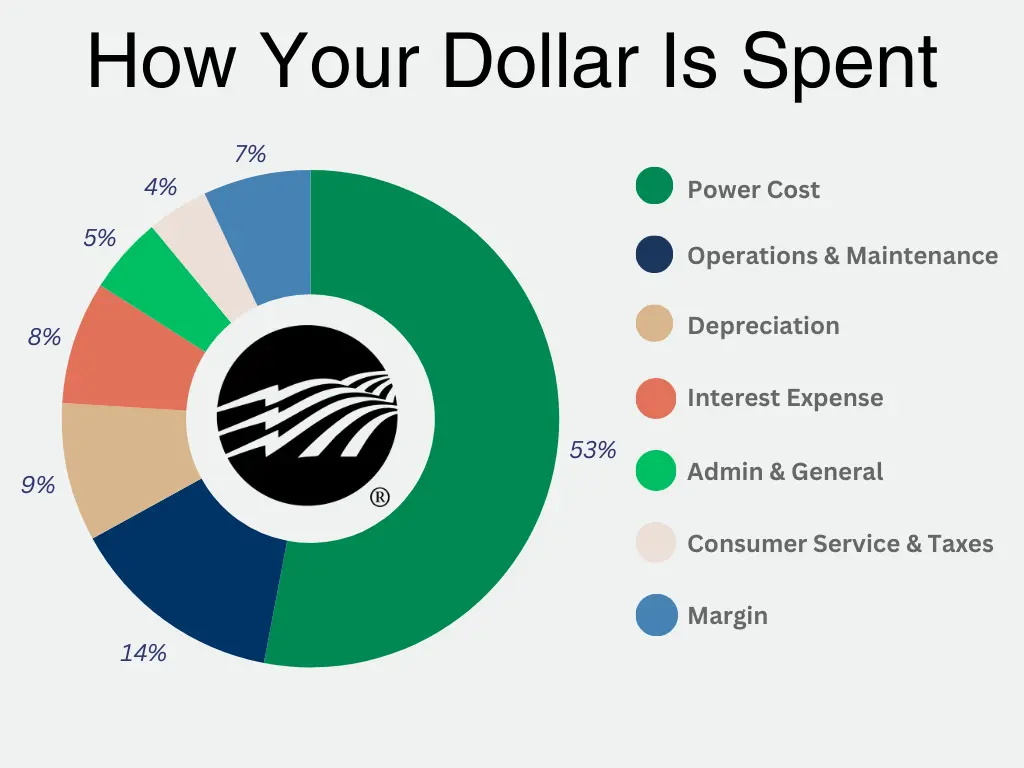
As a member-owned cooperative, we do not raise rates to create profits or shareholder returns. Our rates are set solely to cover the actual cost of providing safe, reliable electric service. Because our wholesale power costs vary based on when and how electricity is used across our system, our rate design reflects those cost drivers to ensure fairness and long-term stability for the whole membership.
Even though individual accounts may vary, our rates are based on what best serves all members collectively. Any revenue we collect above our operating needs is returned to members each September as Capital Credits, distributed according to each member’s energy use.

Rate Stability Highlights
- Last Rate Adjustment: April 2023
- Long-term average annual increase since the 1990’s: Under 1%
- Consistently below utility inflation averages
Understand How and When You Use Electricity
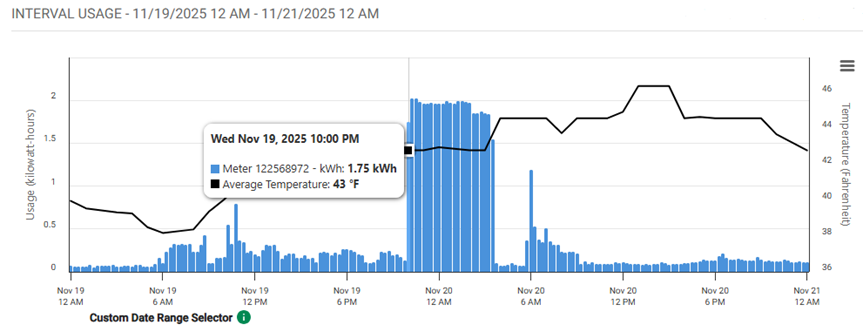
SmartHub helps you understand how and when you use electricity. View monthly, daily, or 15-minute usage trends, compare past bills, and spot opportunities to reduce your costs. It’s an easy way to stay informed and in control of your energy use.
Billing Terms
What is Energy – Kilowatt-Hour (kWh)
Electricity is measured in kilowatt-hours (kWh), and your electric meter tracks how many kWh you use during the month. A kilowatt is 1,000 watts, and one kilowatt-hour is the amount of energy used when you use 1,000 watts for one hour. For example, ten 100-watt light bulbs left on for one hour use 1 kWh of electricity. All of our rates include a kWh energy charge component. For residential and small commercial accounts, the kWh price can vary depending on when the electricity is used, reflecting the times when power costs more to supply.
What is Demand – Kilowatt (kW)
Demand, measured in kilowatts (kW), is how much electricity you are using at a given time. One kilowatt equals 1,000 watts, so using more equipment at once increases demand. For example, a 3 kW dryer and a 4 kW water heater running together create a 7 kW demand. Demand differs from kilowatt-hours (kWh), which measure total energy used over time. Our meters record monthly peak demand using a 15-minute average, and small commercial multi-phase and large commercial rates include a kW demand charge.
What is a Facility Charge
The facility charge is a standard monthly service fee that helps cover the fixed costs for the availability of electric service at your service location. These costs include poles, wires, transformers, meters, and other equipment, as well as system maintenance and outage response labor needed to keep service available and reliable. The facility charge does not cover all fixed costs to operate the system, so remaining costs are recovered through kWh energy charges, kW demand charges, and transformer-related charges where applicable. Facility charges and the way fixed costs are distributed can vary by rate class based on the type of service and the cost to serve that class.
What is an EAC Charge
A monthly line on your bill that adjusts your charges up or down based on changes in the cooperative’s wholesale power costs. The ECA can be positive or negative and is calculated by multiplying the ECA factor shown on your bill by the number of kWh you used that month. Changes in fuel costs, power supply conditions, and overall system demand can affect the ECA.
What is a Transformer
A monthly fee is applied when a member requires, or requests transformer service sized 75 kVA or larger. The charge is $0.11 per kVA per month, based on the transformer capacity installed to serve the account.
What is a kVA Minimum Up-Charge
A kVA Minimum Charge is a minimum monthly charge that may apply when a member requires a transformer larger than the standard 10 kVA included in the facility charge. It helps cover the fixed cost of providing that extra transformer capacity, even in months with low usage.
Example: If a 50 kVA transformer is required, the extra 40 kVA (50–10) at $0.75 per kVA equals a $30 minimum. If your energy charges are less than $30, you pay the difference; if they are more than $30, no minimum upcharge applies.
What is a Transformer Charge
A monthly fee is applied when a member requires, or requests transformer service sized 75 kVA or larger. The charge is $0.11 per kVA per month, based on the transformer capacity installed to serve the account.
What is a Franchise Fee Charge
A Franchise Fee is a percentage of the utility bill set by a city for the utility’s use of public rights of way. It appears as a line item on your bill and is collected by the cooperative and remitted to the city based on your service location.
Rates by City: Central City 5%, Cedar Rapids 4%, Center Point 3%, Coralville 2%, Ely 1%, Hiawatha 3%, Marion 5%, North Liberty 5%, West Branch 1%.
What is a Lot Tax Charge
A Lot Tax (local option sales tax) is percentage of the utility bill set by the county. It appears as a line item on your bill and is collected by the cooperative and remitted to the county based on your service location.
Tax by County: Linn County 1%
What is Iowa Sales Tax Charge
Iowa State sales tax is 6 %, but it does not apply to residential electric service. Electricity used for nonresidential purposes is generally subject to the 6% state sales tax, although certain qualifying business uses may be eligible for exemptions under Iowa law.
What is Avoided Cost
Avoided cost is a credit rate for members with solar or wind who export excess power. Under PURPA, utilities purchase this excess energy at the utility’s avoided cost, which reflects the cost the utility avoids by not buying that power elsewhere.
What is a Reconnection Fee
A $50.00 reconnection fee is required if your meter has been disconnected for non-payment and can be reconnected remotely.
A $100.00 reconnection fee is required if your meter has been disconnected for non-payment and a trip has been made to reconnect the service during regular office hours (Monday – Friday, 7:30 am – 4:00 pm).
If any part of the trip is not during regular office hours, a $150.00 after-hour reconnection fee applies.
What is an Ideal Service Charge
If you no longer need electricity at your location but want to keep your service, there is a monthly idle service charge (facility charge + kVa minimum) to have equipment ready to be energized upon your request.
What is a Late Charge
Any amount owed after the due date (25th of the month) will be assessed as a 1.5% billing late charge.
A $30.00 fee may be assessed for any payment not honored by your bank or credit card company.
Rates at a Glance
This summary includes all available rate options for residential, small commercial, and large commercial and industrial members.
Please see the electric tariff for complete rate details
Residential Rates
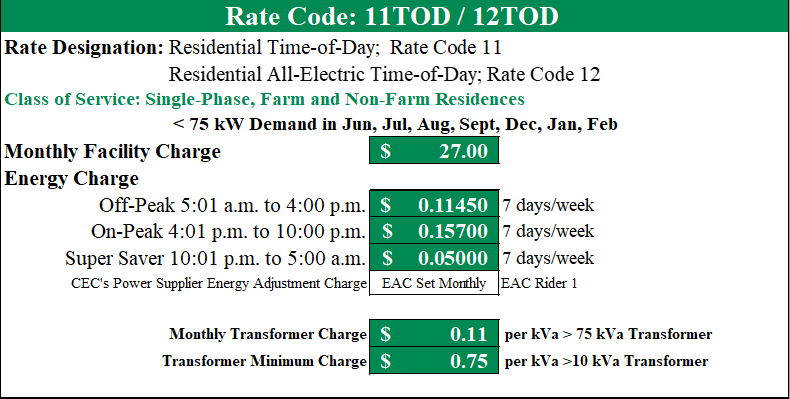
We exclusively offer Time-of-Day (TOD) rates for our residential members to promote fairness and transparency, and to better reflect how we are billed by our power supplier.
Eligibility
- Peak demand (any 15-minute period during the billing monthly) must be less than 75 kW during the billing months of June, July, August, September, December, January, February.
- Account must have habitable dwelling which in includes single-family, multifamily units, and dwellings with farm or commercial usage.
- If a home has separate single-phase service for a garage or shop, the service is considered a small commercial account (13TOD), same rate structure except Iowa Sale Tax is applied.
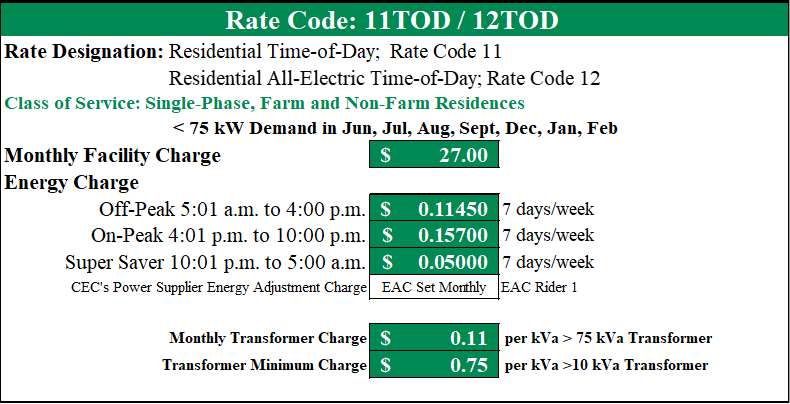
Unlike flat rates, TOD pricing considers when you use electricity not just how much. This matters because:
- Most of Corridor Energy Cooperative’s power supply costs occur during on-peak hours, when overall demand across the grid is highest.
- That means usage during peak hours costs significantly more for both the cooperative and its members.
- By aligning our residential rate structure with these wholesale market realities, we ensure that members who use more during high-demand periods pay their fair share, while those who use less during those hours can save money.
What You Can Do to Lower Your Bill — and the Cooperative’s Costs
When members shift electricity use away from peak hours, we all win. By adjusting a few habits, you can lower your monthly bill and help reduce systemwide costs.
Here are easy ways to make a difference:
- Use Delay high-energy tasks like drying clothes, dishwashing, or EV charging until after 10 PM or before 4 PM.
- Use smart thermostats, timers, and smart plugs to automate your usage.
- Encourage your household to avoid peak usage (4 PM–10 PM) when possible.
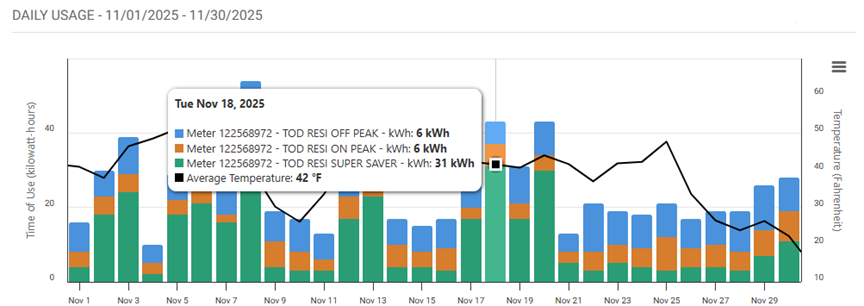
By working together to flatten our demand curve, we can keep rates more stable for all members.
Optional Rates (members are only allowed to be on 1 Optional Rate)
Optional Heat Plus Rate
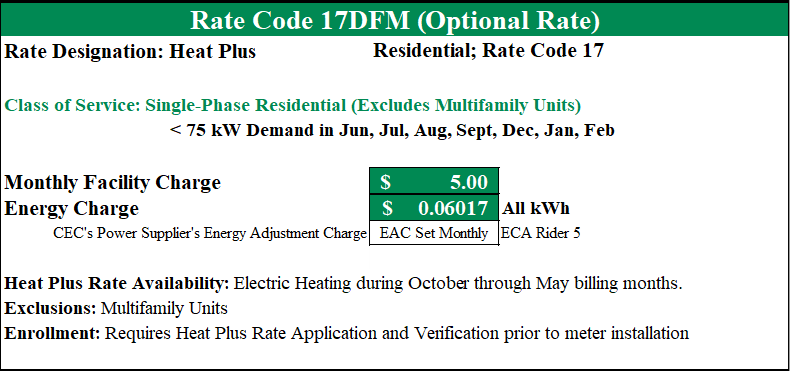
Heat Plus Rate: Corridor Energy Cooperative offers a discounted electric heat rate through our power supplier to improve system load factor during the winter and shoulder seasons. To qualify, electric space heat must be the primary heating source, separately metered and approved by the cooperative, and serve at least 400 square feet. The account must have an electric water heater providing 100 percent of water heating, and the account must be under 75 kW demand.
Optional Alternative Energy Production (Solar and Wind) Rate
Members with approved alternative energy production are on our standard residential Time of Day rate with monthly net metering. Our meter records both energy used from the grid and energy delivered back to the grid within each Time-of-Day period. If generation exceeds usage for the month in a specific time block, excess energy is purchased at the avoided cost rate.
Avoided Cost applies to members who produce electricity through alternative energy systems such as solar or wind. The Public Utility Regulatory Policies Act of 1978 (PURPA) requires utilities to purchase excess energy and capacity produced by qualifying facilities at a rate equal to the utility’s avoided cost. Avoided cost is the cost the utility avoids by purchasing less power from other sources. At Corridor Energy Cooperative, the avoided cost rate is based on the MISO ALTW.ALTW price. MISO is the regional grid operator that coordinates and monitors electricity supply and demand across our area to ensure reliable service.
Small Commercial Rates
Corridor Energy Cooperative offers two small commercial rate options: Single Phase and Multiphase. Each rate is designed to match the service type and equipment required to serve the account.
13 TOD Single Phase Service:
Eligibility:
- Peak demand (any 15-minute period during the billing monthly) must be less than 75 kW during the billing months of June, July, August, September, December, January, February.
- Accounts that do not have habitable dwelling.
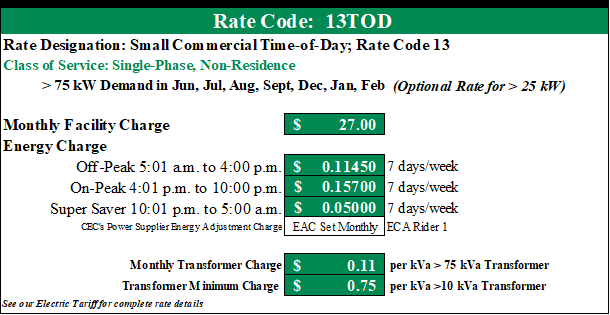
Unlike flat rates, TOD pricing considers when you use electricity not just how much. This matters because:
- Most of Corridor Energy Cooperative’s power supply costs occur during on-peak hours, when overall demand across the grid is highest.
- That means usage during peak hours costs significantly more for both the cooperative and its members.
- By aligning our rate structure with these wholesale market realities, we ensure that members who use more during high-demand periods pay their fair share, while those who use less during those hours can save money.
3MCOM Multiphase Service:
Eligibility:
- Peak demand (any 15-minute period during the billing monthly) must be less than 75 kW during the billing months of June, July, August, September, December, January, February.
- Accounts that do not have habitable dwelling.
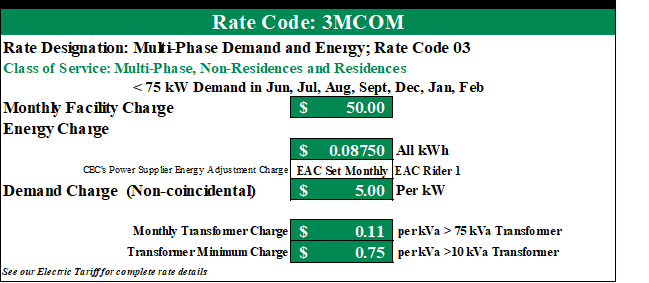
Small Commercial Multiphase service includes both an energy charge (kWh) and a demand charge (kW). The demand charge is based on the highest level of electricity used at one time during the month, which the meter records as a 15-minute average. Demand increases when multiple loads are running at the same time, such as motors, heating equipment, compressors, or other large loads starting together. Shifting flexible use to off peak times and avoiding turning several high load items on at once can help reduce peak demand and lower demand charges.
Small Commercial Optional Heat Plus Rate (Single-Phase Only)
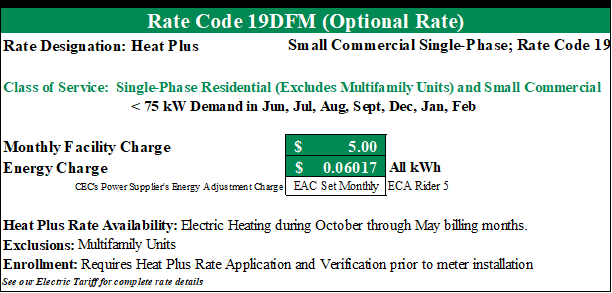
Corridor Energy Cooperative offers a discounted electric heat rate through our power supplier to improve system load factor during the winter and shoulder seasons. To qualify, electric space heat must be the primary heating source, separately metered and approved by the cooperative, and serve at least 400 square feet. The account must have an electric water heater providing 100 percent of water heating, and the account must be under 75 kW demand.
Large Commercial and Industrial Rates
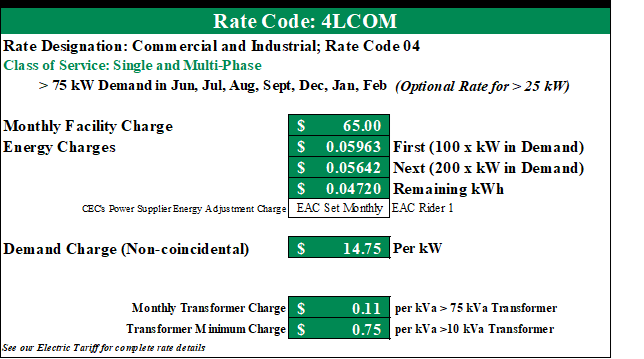
4LCOM:
Eligibility:
- Peak demand (any 15-minute period during the billing monthly) greater than 75 kW during any of the billing months of June, July, August, September, December, January, February.
- Optional for members with greater than 25 kW during any of the billing months of June, July, August, September, December, January, or February.
This rate includes both an energy charge (kWh) and a demand charge (kW). The demand charge is based on the highest level of electricity used at one time during the month, which the meter records as a 15-minute average. Demand increases when multiple loads are running at the same time, such as motors, heating equipment, compressors, or other large loads starting together. Shifting flexible use to off peak times and avoiding turning several high load items on at once can help reduce peak demand and lower demand charges.
Energy charges are structured to reward stronger load factor accounts. Accounts that use energy more consistently throughout the month, rather than in short high-demand spikes, typically achieve a better load factor and a lower effective kWh cost.
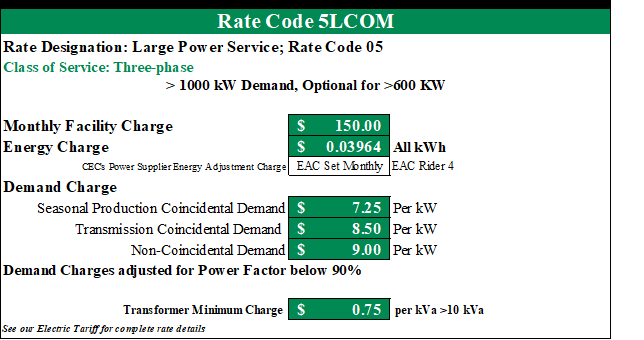
5LCOM:
Eligibility:
- Peak demand (any 15-minute period during the monthly billing) greater than 1000 kW during any of the billing months of June, July, August, September, December, January, February.
- Optional for members with greater than 600 kW during any of the billing months of June, July, August, September, December, January, or February.
The 5LCOM rate is designed for larger loads with a lower kWh energy cost and demand charges that reflect how your load contributes to system peaks. This rate includes three demand components: coincident production demand, coincident transmission demand, and non-coincident demand. Accounts with a high load factor, meaning usage is steady with fewer spikes, typically benefit most from this rate structure.
Coincident Production Demand is based on a seven-month average of your 60-minute demand that occurred at the same time as CIPCO’s system peak during the peak months of December, January, February, June, July, August, and September. This seven-month average is calculated in February and September and remains constant between those months.
Coincident Transmission Demand is based on your 60-minute demand at the time of Corridor Energy Cooperative’s system peak for the month.
Non coincident Demand is your highest 15-minute demand recorded during the month, regardless of when it occurs.
Large Commercial and Industrial Optional Rates
14TOD
Eligibility:
- Must have multiphase service.
- Optional for members with greater than 600 kW during any of the billing months of June, July, August, September, December, January, or February.
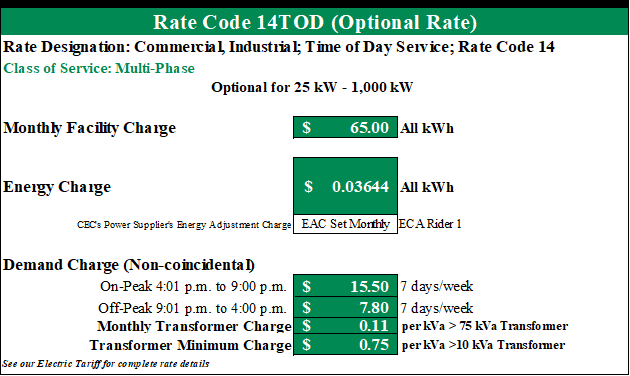
The 14TOD rate is designed for multiphase services with a low, flat kWh energy charge and both on peak and off-peak demand components. Demand is measured as the highest 15-minute average kW during each time period. The on-peak period is 4:01 PM to 9:00 PM, when system costs are typically high, and all other hours are off peak. This rate can be beneficial for high load factor accounts because of the lower kWh cost, and it is often a strong fit when an account’s load drops after 4 PM and stays lower during the evening peak window.
16TOD
Eligibility:
- Participation requires a three-party contract between the member, Corridor Energy Cooperative, and Central Iowa Power Cooperative.
- Members must have backup generation and the ability to shed load if interrupted, and penalties may apply if load is not reduced when called upon.
- This option is available for members with billing demand between 150 and 2,500 kW during any of the following months: June, July, August, September, December, January, or February.
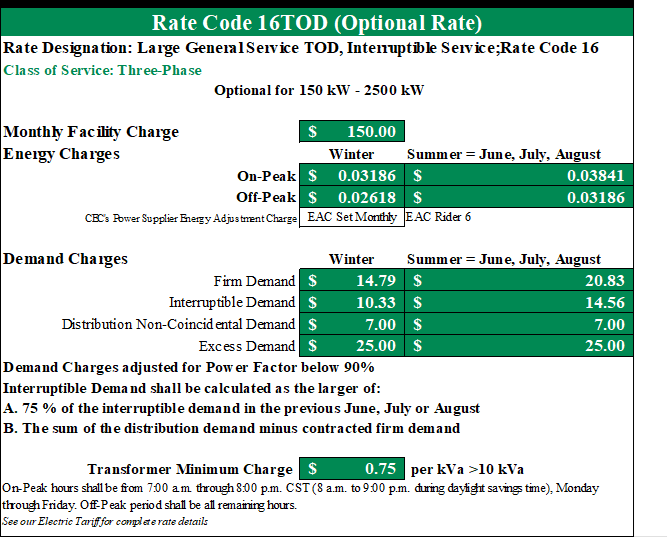
Members enrolled in the interruption program receive a discount under this rate in exchange for being able to reduce load when called upon, which can help lower overall costs.
Questions about commercial rate options?
Contact our Commercial Advisor, Isaiah Borel, at iborel@corridorenergy.coop or 319-249-7309 to discuss available rates and request a rate analysis to help ensure your account is on the best option based on your load profile.
Iowa Sales Tax and Exemptions for Qualifying Industries
In Iowa, sales tax on energy depends on whether the energy is used for residential or nonresidential purposes. Residential electric service is exempt from the 6 percent state sales tax, while most nonresidential energy use is taxable. However, certain industries and activities such as manufacturing, agricultural production, data centers, and other qualifying operations may be eligible for a sales tax exemption on energy or energy related equipment. Eligibility is determined by the Iowa Department of Revenue, and qualifying businesses must submit the appropriate exemption documentation to allow Corridor Energy Cooperative to apply the exemption percentage directly to the bill. The tax exemption certificate is valid for three years.
Corridor Energy does not provide tax exemption assessments, but there are a number of companies that provide Iowa Sales Exemption assessment services.
Iowa Sales Tax Exemption Certificate – Form 31-113a
Corridor Energy Cooperative Electric Tariff
Tariffs are the procedures, policies, rates, fees and charges for Corridor Energy Cooperative in fulfilling its role of furnishing electric service to our members. Tariffs are filed with the Iowa Utilities Commission for information purposes. To view our tariff, click the I ACCEPT link below.
While every effort has been made to ensure that the tariffs are accurate and updated on a timely basis, Corridor Energy Cooperative does not warrant that they are identical in every respect to the tariffs on file and expressly disclaims any responsibility or liability for any differences.
Copies of the tariff are available by calling our office at 319-377-1587
I have read and accept the following disclaimer:
I ACCEPT